
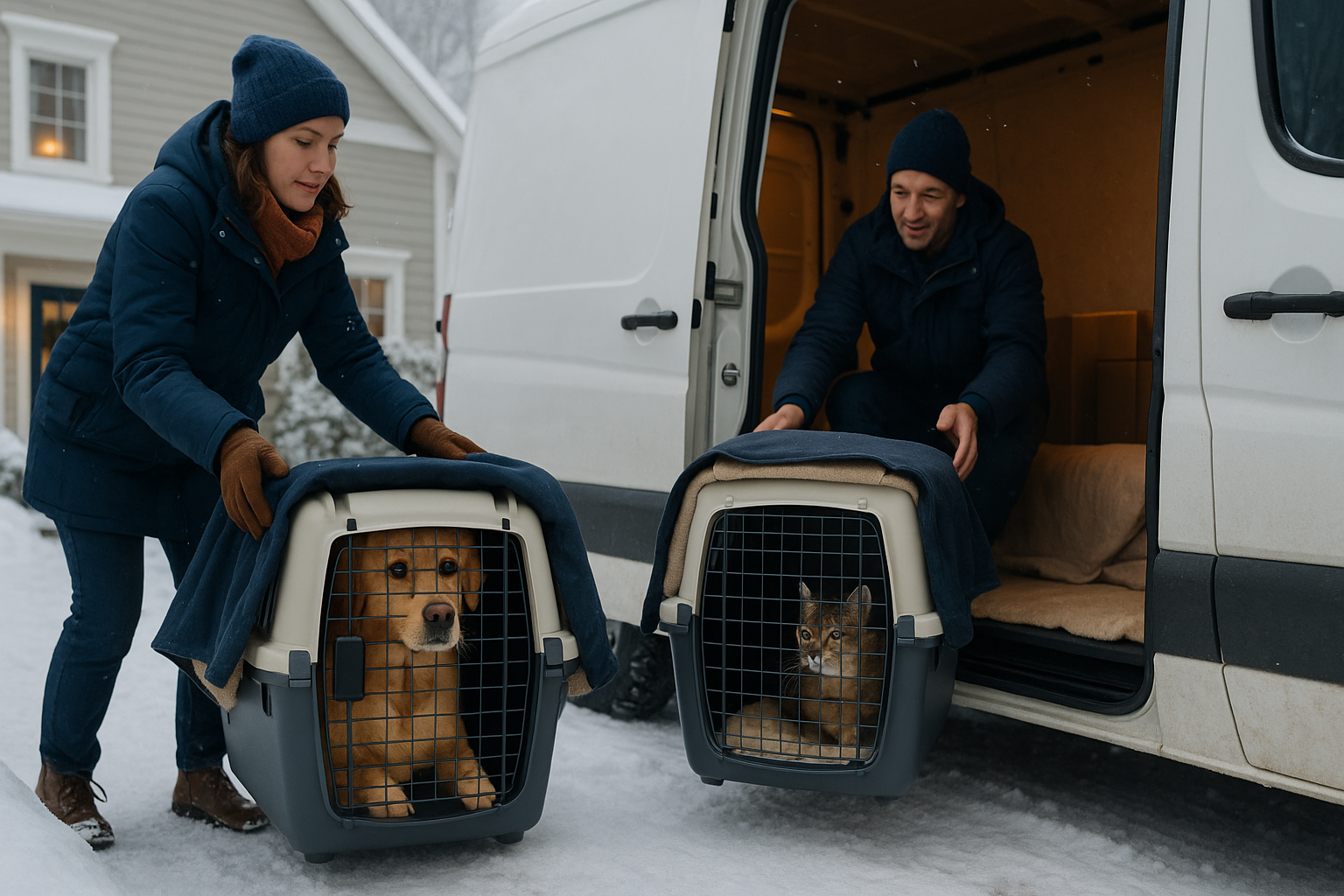
Cold-Weather Pet Transport: Crate Covers, Venting & Vet Docs
Moving or traveling with a pet in winter is a very different project than in mild weather. You’re balancing warmth, ventilation, and legal paperwork, all while trying to keep a furry family member calm and safe. This guide walks you through how to set up the crate, use covers without blocking air, and get the right veterinary documents in place.
Quick answer:
To transport pets safely in cold weather, use a well-ventilated travel crate with a breathable cover, never block all air vents, add dry bedding, keep the crate in a climate-controlled vehicle, limit outdoor exposure, and travel only after your veterinarian clears your pet and provides any required health certificates.
1. Why Cold-Weather Pet Transport Needs Its Own Game Plan
Winter adds extra risk for pets: hypothermia, frostbite, icy roads, sudden storms, airline embargoes, and power outages. Veterinary groups like the ASPCA, AVMA and AAHA all stress that cold weather can be just as dangerous for pets as extreme heat, especially when wind, wet fur and limited shelter are involved. A good rule of thumb many humane organizations repeat: if it’s too cold for you to stand outside comfortably in a coat, it’s probably too cold for your dog or cat to wait there in a crate. Short-haired, very small, senior or medically fragile pets are at higher risk and may need stricter limits on outdoor time. Cold-weather pet transport planning focuses on three big questions:- Can this trip be timed around the weather? Sometimes shifting a move by a few days avoids an ice storm and makes everything safer.
- Is your pet medically ready? That includes overall health, vaccinations and any medications that affect temperature regulation or circulation.
- Is your setup winter-safe? The crate, cover, bedding, vehicle and paperwork all have to work together so your pet stays warm and well ventilated.
2. Is Winter Travel Right for Your Pet?
Before you dive into crate covers and vet forms, decide whether winter travel is truly the best option for your animal.2.1 Questions to ask before committing
- Is the timing flexible? If the trip is not tied to a hard deadline (like a military report date or lease end), talk with your mover or airline about safer dates.
- What’s your pet’s health status? Chronic heart, lung, joint or endocrine diseases can make cold temperatures more risky. Your vet may adjust meds or recommend postponing travel.
- What’s their coat and body type? Thin-coated breeds, toy breeds, very lean dogs and many cats lose body heat quickly and often need extra layers and stricter limits on outdoor exposure.
- How stress-sensitive are they? Anxious pets may pant heavily or stop eating on travel days, which can make it harder to stay warm and hydrated.
2.2 Talk to your veterinarian early
Schedule a pre-travel appointment at least 3–6 weeks before a winter move, more if you might need international paperwork. USDA APHIS recommends that international pet export certificates be issued by a USDA-accredited veterinarian and, in many cases, endorsed by a USDA office—steps that can take multiple visits and mailing time. At this visit, ask your vet to:- Review your pet’s cold tolerance and any special risks.
- Plan vaccination timing so certificates are valid for your route.
- Discuss joint support, skin/paw care and any travel-safe calming options.
- Map out which health certificates or blood tests you’ll need for your route and travel mode.
2.3 Choose the safest mode: car, ground transport or air
- Personal vehicle: Great control over stops, temperature and schedule. Best for many cats and dogs on regional moves.
- Professional ground transport: Useful for longer distances when you can’t drive yourself. Look for climate-controlled vehicles, experienced handlers and clear communication protocols.
- Air travel (in-cabin or cargo): Often fastest but heavily regulated in winter. Airlines may freeze cargo bookings if temperatures fall below certain thresholds and can require special acclimation paperwork (more on that below).
3. Crate, Cover & Ventilation Basics
In cold weather, your pet’s crate becomes both their “coat” and their seatbelt. The goal is a setup that blocks drafts and snow while still allowing safe airflow.3.1 Pick the right crate size & type
For most dogs and cats, the safest travel crate is one that allows them to stand up, turn around and lie down comfortably, with solid walls and secure doors. Airlines and many ground carriers follow IATA live animal container rules, which require adequate space, strong materials and secure fasteners.- Too small: higher stress, poor circulation, increased frostbite risk on paws and ears.
- Too large: harder for your pet to conserve body heat; more air to warm inside.
- Solid plastic or composite walls (instead of bare wire) to cut drafts.
- Multiple ventilation openings on sides and door.
- Leak-proof bottom that can hold an absorbent pad plus bedding.
3.2 How much ventilation is “enough” in winter?
It’s tempting to “seal up” the crate to keep your pet warm, but that can be dangerous. IATA container guidance and airline crate rules emphasize that ventilation openings must not be blocked by labels, padding or covers, and that crates should let fresh air move in and out at all times. A good practical rule:- At least one full side (often the door) should remain uncovered and unobstructed.
- Top and side vents should not be taped or blocked with thick fabric.
- If you see condensation on the inside walls, the crate might be too sealed.
3.3 Choosing & using winter crate covers safely
Crate covers can make the space darker, quieter and warmer, but only when they still allow air to flow. Veterinary-backed crate cover guides generally recommend lightweight, breathable fabrics, partial coverage and close monitoring to avoid respiratory or overheating issues.| Good practice | Avoid |
|---|---|
| Covering 2–3 sides to block drafts while leaving one side fully open. | Wrapping the entire crate in heavy blankets or plastic so no vents are visible. |
| Using breathable materials (e.g., canvas, cotton, mesh panels). | Using airtight tarps, plastic sheeting or multiple thick comforters. |
| Rolling panels up or down depending on room/car temperature. | Taping or zip-tying covers so they can’t be quickly removed in an emergency. |
| Checking under the cover for a warm nose, normal breathing and relaxed posture every 15–30 minutes. | Leaving your pet covered and unattended in a parked car or unheated area. |
3.4 Bedding, layers & safe warmth upgrades
Warmth should start with safe, dry bedding:- Thick, washable crate pads or vet-bed-style fleece.
- Layered blankets or towels (secured so they cannot bunch into one corner).
- For some dogs, a fitted sweater or coat, especially for short-haired or small breeds.
3.5 Where to put the crate in your car or van
In a personal vehicle or moving truck, consider:- Location: Place the crate in the main cabin, not an open truck bed or unheated cargo area.
- Elevation: Use a rubber mat or folded moving blanket under the crate to buffer cold floors.
- Airflow: Keep vents aimed near—but not directly blasting into—the crate; avoid blocking them with boxes or luggage.
- Sun and drafts: In bright but freezing conditions, partial sun through a window can help, but monitor so the crate does not overheat.
4. Vet Docs & Legal Basics for Cold-Weather Trips
Winter doesn’t change the core paperwork for pet transport, but it does make timing and details more critical. Airlines and some ground carriers can deny boarding if documents are missing, expired or incomplete.4.1 Close-to-home & intrastate moves
If you’re staying within the same state, requirements are usually simpler. Many states do not require a health certificate for intrastate moves, but landlords, boarding kennels, campgrounds or hotels may ask for proof of current vaccines or a recent exam. When in doubt, carry a copy of your vaccination history and a brief note from your vet.4.2 Interstate moves in the U.S.
For travel from one U.S. state or territory to another, the destination state sets the legal requirements. USDA APHIS maintains a state-by-state tool that explains what’s needed (often a Certificate of Veterinary Inspection and current rabies documentation) before a pet can legally enter. Typical documents for interstate travel may include:- Certificate of Veterinary Inspection (CVI): Issued shortly before travel (commonly within 10–30 days, depending on the state).
- Rabies vaccination certificate: Showing vaccine type, lot and expiration.
- Microchip documentation: Required by some states and strongly recommended for all traveling pets.
4.3 International & return-to-U.S. travel
International moves in winter require even more lead time. Many countries require a microchip, specific vaccines, blood tests and an endorsed health certificate. USDA APHIS emphasizes that export health certificates for pets must be issued by a USDA-accredited veterinarian and, for many destinations, endorsed by a USDA office. If you’re bringing a dog into the United States after international travel, updated CDC rules effective August 1, 2024 require that dogs be at least six months old, microchipped, appear healthy on arrival, and have a CDC Dog Import Form receipt plus additional documentation depending on recent country risk for rabies. Always check the latest CDC and USDA guidance before finalizing flights.4.4 Airline cold-weather paperwork (acclimation certificates)
In cold weather, some airlines require special veterinary statements for pets traveling in cargo. These are often called acclimation certificates or acclimation statements. They are typically attached to the health certificate and indicate the temperature range your pet is cleared to tolerate during transport. Airline and pet-relocation guidance commonly notes that:- Many airlines limit pet cargo travel when ground temperatures are below about 45 °F, unless an acclimation certificate is on file.
- Even with acclimation paperwork, airlines may refuse travel at extreme lows (commonly around 20 °F or below) for safety.
- Veterinarians do not guarantee your pet’s tolerance of temperatures outside normal ranges; these certificates are conservative guidelines, not promises.
4.5 Quick reference: common travel documents by trip type
| Trip type | Typical documents | Who issues them? |
|---|---|---|
| Local move within one state | Vaccination records; optional recent exam note. | Your regular veterinarian. |
| Interstate road trip | CVI (health certificate), rabies certificate, microchip documentation if required. | Licensed vet (often USDA-accredited); some states also involve state vets. |
| International move (U.S. to another country) | Destination-specific export health certificate, rabies and other vaccines, sometimes blood tests and parasite treatments. | USDA-accredited veterinarian plus USDA endorsement office. |
| Return to U.S. with a dog | CDC Dog Import Form receipt, microchip proof, rabies documentation and travel-history-based requirements. | Owner, veterinarian, and in some cases government authorities at origin. |
| Air cargo in cold weather | Health certificate, airline forms and possibly an acclimation certificate or statement. | Licensed (often USDA-accredited) veterinarian; airline acceptance staff. |
5. Cold-Weather Pet Transport Timeline & Checklist
Use this timeline as a starting point and adjust based on your route, species and vet’s advice.5.1 Four–six weeks before departure
- Confirm your move or travel dates and main route.
- Book a pre-travel exam with your veterinarian (sooner if international).
- Discuss any chronic health conditions and winter-specific concerns.
- Measure and purchase a compliant travel crate.
- Start daily “crate practice” at home with treats and short sessions.
- Research requirements using the USDA Pet Travel and state animal health pages for your destination.
5.2 7–10 days before departure
- Have your vet issue any required health certificates (watch exact timing windows).
- Request an acclimation statement if your airline or shipper requires one.
- Print multiple copies of all paperwork and store them in a waterproof folder.
- Test your crate cover and bedding in real weather for short periods while you’re present.
- Prepare a pet travel kit: food, water, medications, collapsible bowls, extra leash, waste bags, towels, and a basic first-aid kit.
5.3 Travel-day checklist
- Check weather and road/flight status early.
- Feed a lighter-than-normal meal, as directed by your vet or airline guidelines.
- Offer water but avoid overfilling bowls inside the crate; use no-spill designs where possible.
- Let your pet exercise and relieve themselves before departure.
- Dress them appropriately (coat, booties if needed) for outdoor transitions.
- Confirm crate labels, contact info and “Live Animal” stickers are secure and not blocking vents.
5.4 On the road or in the air
- Maintain a comfortable cabin temperature; avoid extremes of hot or cold.
- Stop regularly on road trips to check your pet’s ears, paws and body temperature by touch.
- Watch for shivering, lethargy, pale gums or confusion—possible signs of cold stress or hypothermia.
- Never leave a crated pet alone in a parked car in freezing conditions, even “just for a few minutes.”
5.5 Arrival & first 48 hours
- Move your pet into a warm, draft-free indoor space right away.
- Offer water first, then small meals as appetite returns.
- Keep walks short until everyone has adjusted to the new climate.
- Rebuild routines (sleep, feeding, bathroom breaks) as quickly as possible.
6. Special Cases: Puppies, Seniors & Brachycephalic Breeds
Certain pets need extra caution in cold weather:- Puppies & kittens: Immature temperature regulation, higher energy needs and limited vaccine protection make them poor candidates for non-essential winter travel. Ask your vet whether delay or special arrangements are safer.
- Senior pets: Arthritis, heart disease and kidney disease often flare in cold weather; extra padding, shorter trips and frequent check-ins are critical.
- Brachycephalic (short-nosed) breeds: Bulldogs, pugs, Persian cats and similar breeds can struggle with both heat and cold, and many airlines restrict or prohibit them in cargo. Sedation is particularly risky for these pets.
7. When to Use Professional Pet Transport (and How AFM Helps)
Cold-weather logistics can be overwhelming when you’re also juggling movers, kids, work and housing. Professional support is worth considering if:- You’re doing a long-distance or cross-country move in mid-winter.
- Your pet has medical or behavioral needs that require extra monitoring.
- You’re coordinating air and ground segments and want fewer hand-offs.
- Pet Transport Services for ground moves designed around your animal’s comfort and schedule.
- Expert long-haul moving services that keep your arrival, unloading and pet hand-off in sync.
- Crate & Specialty Packing Services to protect kennels, carriers and sensitive pet equipment in transit.
- Temperature-controlled storage for items that shouldn’t freeze while you’re between homes.